You know your small business needs content marketing. But every article you read makes it sound complicated or expensive. They talk about editorial calendars, distribution strategies, and marketing funnels. You just want to attract more customers without spending thousands of dollars or hiring a team.
Good news. Content marketing doesn’t have to be complex. You can create helpful content that brings people to your business using free tools and a few hours each week. The basics work better than fancy tactics anyway.
This guide walks you through everything you need to start content marketing from scratch. You’ll learn how to pick topics your customers actually care about, choose simple formats you can handle yourself, and measure what’s working so you don’t waste time. No jargon. No overwhelming tech setup. Just a clear path from zero to your first published content that brings in real customers.
Why content marketing matters for small business
Your small business competes with companies that have bigger budgets and established reputations. Content marketing for small business levels the playing field because helpful content builds trust faster than any advertisement. When potential customers find your blog post, video, or social media advice that solves their problem, they remember you when they’re ready to buy.

Build trust without paid ads
Most people ignore ads but actively search for answers to their problems. You create valuable content that shows up when they search, and they see you as the helpful expert instead of just another company trying to sell something. A single blog post explaining how to solve a common problem in your industry can bring dozens of potential customers to your website every month. These visitors arrive already interested in what you offer because your content addressed their specific need.
Attract customers who are ready to buy
Content helps you connect with people at different stages of their buying journey. Someone searching "how to fix" wants education. Someone searching "best options for" wants comparison. Your content meets them where they are and guides them toward your solution naturally. This approach brings in qualified leads who have already learned about their problem and your expertise through your content.
When you answer real questions your customers ask, they arrive at your business already half-convinced you can help them.
Create assets that work for years
Unlike paid ads that stop working the moment you stop paying, content continues attracting customers long after you publish it. A blog post you write today can bring in customers for the next three years or more. You invest time once and get ongoing returns. Each piece of content becomes part of a growing library that works around the clock to bring people to your business.
Step 1. Get clear on your goals and audience
You can’t create effective content marketing for small business without knowing exactly what you want to achieve and who you’re trying to reach. Most business owners skip this step and wonder why their content doesn’t bring results. They write blog posts about whatever seems interesting instead of focusing on topics that move their business forward. Clear goals and a defined audience give every piece of content a purpose.
Define what success looks like
Your content marketing needs specific goals tied to your business needs. Vague aims like "get more traffic" won’t help you make decisions about what to create. Instead, pick measurable objectives you can track over time. Start with one primary goal for the next three months.
Common content marketing goals that work for small businesses:
- Bring 100 new visitors per month to your website through search
- Collect 50 email addresses from people who want your advice
- Get 10 qualified leads who ask about your services
- Reduce the same 5 questions you answer every day by half
- Book 5 discovery calls with potential customers
Pick the goal that solves your biggest business problem right now. If nobody knows you exist, focus on traffic. If you have visitors but no way to stay in touch, build your email list. Write down your goal and the specific number you want to hit.
Identify your ideal customer
Your content needs to speak directly to the person most likely to buy from you. Generic content that tries to appeal to everyone ends up connecting with no one. Think about your best customers and what they have in common. These patterns reveal your ideal audience.

The more specifically you can describe your ideal customer, the easier it becomes to create content that makes them feel understood.
Answer these questions to define your audience:
- What problem keeps them up at night that your business solves?
- What words do they use when describing this problem (not industry jargon)?
- Where do they go online to find answers (Google, YouTube, specific forums)?
- What level of knowledge do they have (complete beginner, some experience, advanced)?
- What objections or fears stop them from buying solutions like yours?
Write a one paragraph description of your ideal customer that includes their main problem, their current situation, and what they’re trying to achieve. Reference this description every time you create content to stay focused on the right audience. This simple exercise stops you from wasting time on content that attracts the wrong people.
Step 2. Choose simple content formats
You don’t need to master every content type to succeed at content marketing for small business. Most small business owners who try to do everything (blog posts, videos, podcasts, infographics, email newsletters) end up doing nothing well. Instead, pick one or two formats you can actually maintain and do them consistently. The format matters less than showing up regularly with helpful information your audience needs.
Start with blog posts
Blog posts give you the biggest return for the least technical skill. You write answers to questions your customers ask, publish them on your website, and search engines send people to those answers for years. Each post becomes a permanent asset that works while you sleep. Blog posts also require minimal equipment (just a computer and free website) compared to video or audio content.
Write posts between 800 and 1,500 words that answer one specific question completely. Shorter posts rarely rank well in search results. Longer posts take too much time for most small business owners to maintain consistently. Focus your posts on these proven formats:
- How-to guides that walk through solving a specific problem
- Comparison posts that help readers choose between options
- Answer posts that directly address common customer questions
- Case studies showing real results you’ve achieved for clients
The best blog post answers one question so thoroughly that readers don’t need to visit another website.
Add video once you’re comfortable
Video content builds trust faster than text because people see your face and hear your voice. You don’t need fancy equipment to start. Record short videos on your smartphone answering the same questions you write about in blog posts. Post these videos on your website, YouTube, or social media where your audience spends time.
Keep videos under three minutes when starting out. Longer videos require more editing skill and more viewer commitment. Simple video formats that work include quick tips, product demonstrations, behind-the-scenes looks at your process, and customer success stories. Record multiple videos in one session to build up your library efficiently.
Pick one social media platform
Choose the single platform where your ideal customers actually spend time, not where you personally prefer hanging out. Business owners waste hours posting content across five platforms when focusing on one would bring better results. Use social media to share your blog posts and videos, answer questions, and start conversations that lead people back to your website where you can capture their contact information.
Step 3. Plan, create and publish your content
You need a repeatable process for content marketing for small business that doesn’t overwhelm your schedule. Most business owners create content randomly when they feel inspired, then stop after a few weeks when inspiration fades. A simple system keeps you consistent without burning out. Planning your topics ahead of time eliminates the paralysis of staring at a blank screen wondering what to write about.
Create a simple content calendar
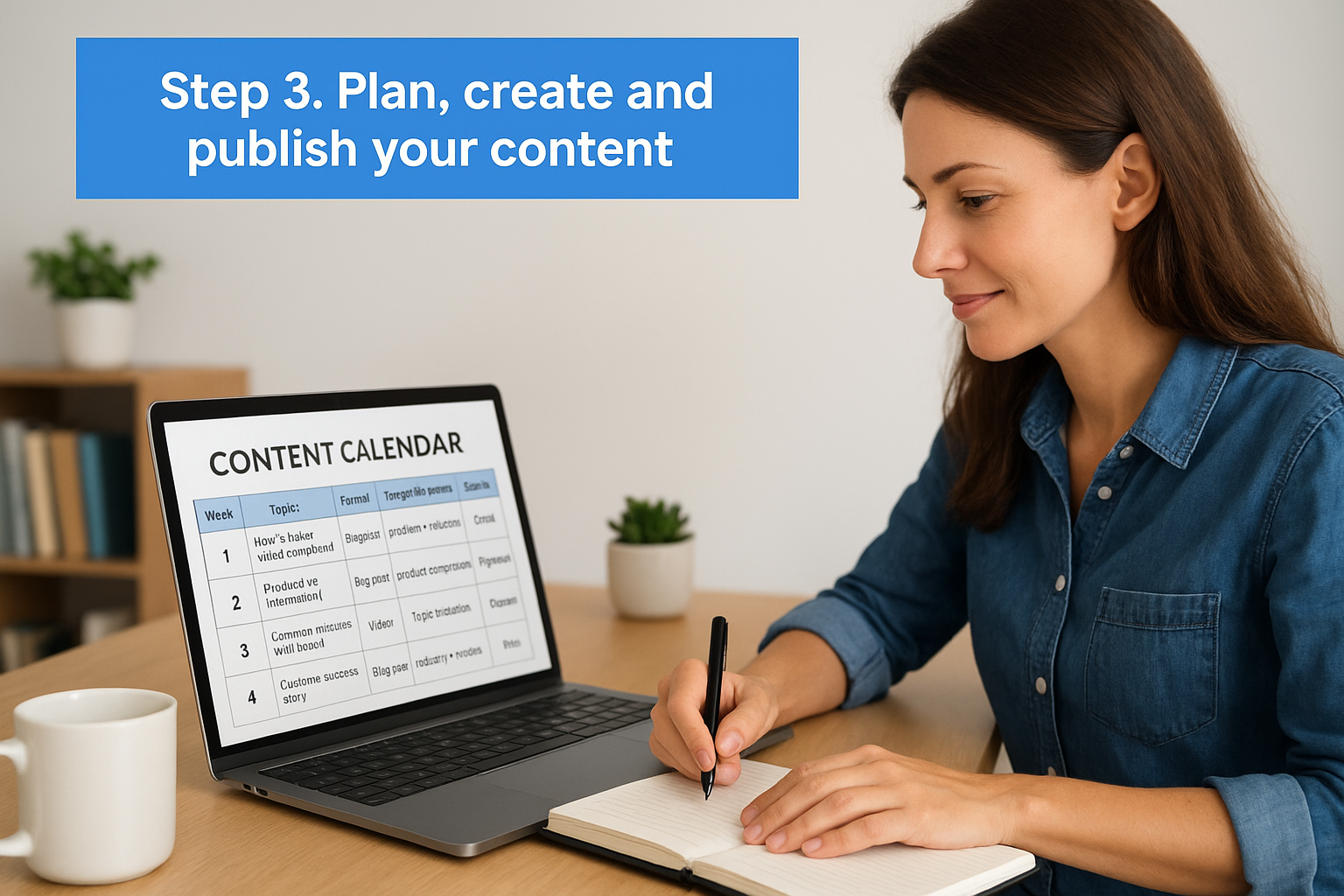
Start with a spreadsheet or document that lists your content topics for the next four weeks. You don’t need fancy software. Write down four to eight topic ideas based on questions your customers ask repeatedly or problems your product solves. Schedule one or two pieces of content per week depending on your available time.
Your basic content calendar should include:
| Week | Topic | Format | Target Keyword | Status |
|---|---|---|---|---|
| 1 | How to [solve specific problem] | Blog post | problem + solution | Draft |
| 2 | [Product] vs [Alternative] | Blog post | product comparison | Planned |
| 3 | Common mistakes with [topic] | Video | topic mistakes | Planned |
| 4 | Customer success story | Blog post | industry + results | Idea |
This simple structure keeps you organized without complicated tools. Review your calendar every Sunday evening and update it with new ideas as customers ask questions during the week. When you spot patterns in questions, add those topics to future weeks.
Write content that answers completely
Open a document and write everything someone needs to know about your topic from start to finish. Don’t assume they know basic terminology or have background knowledge. Break complex topics into numbered steps or short sections with descriptive subheadings. Each section should cover one specific aspect of the topic.
Write like you’re explaining the topic to a smart friend who knows nothing about your industry.
Follow this proven structure for blog posts:
- Start with the problem (2-3 sentences showing you understand their struggle)
- Present your solution (1 paragraph overview of what they’ll learn)
- Break the solution into clear steps or sections (the main body)
- End with next steps (what they should do now with this information)
Use short paragraphs (3-4 sentences maximum) and simple words. Read your draft out loud to catch confusing sections. If you stumble while reading, your audience will stumble too.
Publish with basic SEO
Add your target keyword to your title, first paragraph, and two or three times naturally throughout the content. Don’t stuff keywords in every sentence. Search engines understand context now. Write your page title under 60 characters so it displays fully in search results.
Before you hit publish, complete this checklist:
- Title includes main keyword and promises clear benefit
- First paragraph explains exactly what readers will learn
- Subheadings break up text every 200-300 words
- At least two internal links to other pages on your website
- One external link to an authoritative source if relevant
- Images compressed to load quickly (under 200KB each)
Publish your content on the same day each week to build a habit. Consistency matters more than perfection. You can always update and improve posts later as you learn what works.
Step 4. Promote and measure on a small budget
Creating content means nothing if nobody sees it. You need simple promotion tactics that don’t cost money and a basic measurement system to know what works. Most small business owners either skip promotion entirely or waste time on platforms where their customers don’t exist. Effective content marketing for small business focuses your limited time on the few promotion channels that actually bring customers to your door.
Share content where your audience gathers
Post your new content in the three places where your ideal customers already spend time online. Stop trying to be everywhere. Pick the platforms where you’ve seen your target audience ask questions or discuss topics related to your business. Share each piece of content once on these platforms with a clear explanation of what readers will learn and why it helps them.

Your promotion checklist for each content piece:
- Post to your email list (if you have one) with personal context about why you wrote it
- Share in one relevant online community (Facebook group, LinkedIn group, Reddit subreddit) where you’re an active member
- Post to your one chosen social media platform with the specific problem it solves
- Answer related questions on Google Business Profile or industry forums by linking to your content
- Email three past customers who asked about this topic and mention you created a resource for them
This focused approach takes 30 minutes per content piece and reaches people who actually care about your topic. Quality matters more than quantity when promoting.
The best promotion happens when you genuinely help someone by sharing your content as the answer to their specific question.
Track what brings actual customers
Set up free Google Analytics on your website to see which content attracts visitors and which pages they view before contacting you. Check your analytics every two weeks and look for patterns in your top-performing content. This simple habit shows you what topics resonate with your audience so you create more of what works.
Track these essential metrics in a simple spreadsheet:
| Content Piece | Published Date | Page Views (Month 1) | Email Signups | Customer Inquiries |
|---|---|---|---|---|
| How to [topic] | Jan 8 | 127 | 3 | 1 |
| [Comparison post] | Jan 15 | 89 | 1 | 0 |
Record actual business results (email signups, phone calls, quote requests) alongside traffic numbers. Many posts with high traffic bring zero customers while posts with modest traffic convert readers into buyers. Focus your future efforts on topics that bring qualified leads who actually want what you offer.
Moving forward with confidence
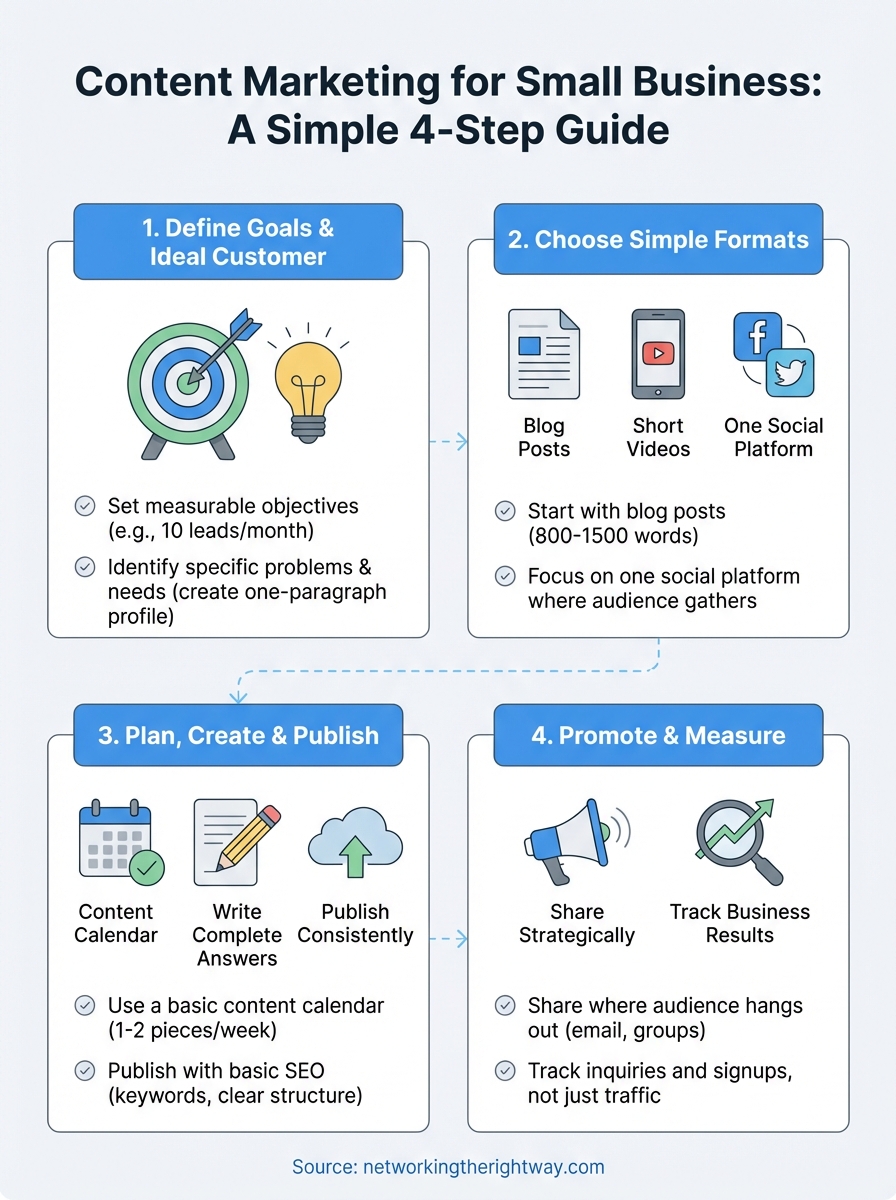
You now have everything you need to start content marketing for small business without expensive tools or complicated strategies. Pick one content format you can handle consistently, create a simple calendar with four topics, and publish your first piece this week. The businesses that succeed with content marketing don’t do everything perfectly from day one. They start small, stay consistent, and learn what works through actual experience instead of endless planning.
Your first few content pieces won’t be perfect, and that’s completely normal. Each piece you create teaches you something about what your customers respond to and what topics bring actual business results. Start with the goal and audience you defined in step one, then let real feedback guide your next steps. If you want a simple way to build a business online with step-by-step guidance, we can help you get started today.