
You see successful businesses posting blogs, videos, and social media updates that attract customers without aggressive selling. You want those results too. But when you try to figure out content marketing, you hit a wall. The advice feels overwhelming. The tools seem complicated. You might have even started before and given up because nothing happened.
Here’s what nobody tells you: content marketing works when you keep it simple. You don’t need fancy software or a big budget. You need a clear plan and the willingness to show up consistently. Create helpful content your audience actually wants. Share it where they already spend time. Track what works and do more of it.
This guide walks you through exactly how to start content marketing from scratch. You’ll learn what content marketing is and why it matters for your business. Then you’ll follow four straightforward steps to launch your first campaign within 30 days. No confusing jargon. No complex strategies. Just practical advice you can use right now to start attracting customers through valuable content.
What content marketing is and why it matters
Content marketing means creating helpful information that solves problems for your target customers. You write blog posts, record videos, or share tips on social media. Instead of interrupting people with ads, you attract them with useful content they actually want to consume. When you consistently deliver value, potential customers trust you and eventually buy from you.
The simple definition
Content marketing for beginners boils down to three actions. First, you identify what your audience struggles with or wants to learn. Second, you create content that helps them with those specific challenges. Third, you publish that content where your audience already spends their time online. The content itself becomes your marketing tool because it demonstrates your expertise and builds relationships with potential customers.
Content that helps people naturally attracts the right customers to your business.
Why it works for beginners
Traditional advertising costs money every time someone sees your message. Content marketing works differently. You create one piece of content that can attract visitors for months or even years. A single blog post can bring you new leads long after you publish it. This makes content marketing perfect for small budgets and people just starting out.
You don’t need technical skills to start. Pick a format you’re comfortable with. If you like writing, start a blog. If you prefer talking, record simple videos on your phone. The barrier to entry is low, and you can learn as you go. Many successful content marketers started with zero experience and built profitable businesses by sharing what they learned along the way.
People over 50 often have decades of real-world experience and stories to share. That experience translates directly into valuable content that resonates with your audience. You’ve already solved problems and learned lessons that others need to hear about.
Step 1. Pick your audience and clear goal
Content marketing for beginners fails when you try to help everyone with everything. You need two specific decisions before you create anything. First, decide exactly who you serve. Second, choose one clear goal your content will achieve. These choices shape every piece of content you create and keep you focused when you feel overwhelmed.
Define who you help
Write down one specific person you want to reach. Think about someone you know or have met who represents your ideal customer. Describe their age range, main problem, and where they spend time online. The more specific you get, the easier your content becomes to create.

Good examples of specific audiences include:
- Women over 50 who want to start an online business but feel intimidated by technology
- Retirees looking for ways to earn extra income without leaving home
- Small business owners who tried social media marketing and saw no results
Bad examples say “everyone” or “people who need help.” You can’t write helpful content when your audience stays too broad. Pick the one group you understand best and focus there first.
The narrower your audience, the more powerfully your content connects with them.
Set one measurable goal
Choose one specific outcome you want from your content marketing. Make sure you can track whether you achieved it with actual numbers. Your goal might be getting 100 email subscribers in 90 days, booking five consultation calls per month, or making three sales from content in 60 days.
Write your goal using this format: I will achieve [specific number] of [specific result] by [specific date]. For example: “I will gain 50 email subscribers by March 31, 2026.” This format forces you to be concrete and gives you a clear target to measure your progress against.
Step 2. Choose your main content format and channel
You don’t need to be everywhere doing everything. Content marketing for beginners succeeds when you pick one format you can create consistently and one channel where your audience already gathers. This focused approach lets you build momentum instead of spreading yourself too thin across multiple platforms.
Match format to your comfort zone
Start with the content type that feels natural to you. If you enjoy writing and can explain ideas clearly in text, begin with blog posts. People who prefer talking should start with video or audio content. Your comfort level directly impacts how consistently you create, and consistency matters more than perfection when you’re starting out.

Written content includes blog posts, email newsletters, and social media captions. You can create these on any device and edit them before publishing. Written formats work well if you process ideas better through typing or if you want permanent, searchable content that ranks in search engines over time.
Video content lets you show your personality and demonstrate visual concepts. Record simple talking-head videos on your smartphone. You don’t need expensive equipment or editing software to start. Video creates a stronger personal connection and often performs well on social media platforms.
Audio content like podcasts gives you flexibility to record while walking or during commutes. Your audience can consume audio while multitasking. This format suits people who prefer speaking over writing and want to build intimate connections through voice.
Choose the format you’ll actually create every week, not the one you think you should do.
Pick one platform to start
Select one specific platform where your target audience spends time daily. Research where people like your ideal customer look for information. Ask existing customers or people in your target group which platforms they use most often.
Platform options include:
- Your own website blog (you own the content and traffic)
- YouTube (best for how-to videos and demonstrations)
- Facebook groups (strong for community building and older demographics)
- LinkedIn (professional audiences and business topics)
- Email newsletter (direct connection with subscribers)
Begin with one platform for 90 days before adding others. Master creating and publishing content there first. Track which posts get the most engagement so you understand what resonates with your audience.
Step 3. Plan topics and a simple 30 day calendar
Planning eliminates the daily stress of figuring out what to create. You need a list of specific topics and a publishing schedule that tells you exactly what to post and when. Content marketing for beginners becomes manageable when you batch your planning once per month instead of scrambling for ideas every single day.
Find topics your audience searches for
Start by listing ten problems your audience faces right now. Think about questions people ask you, complaints they share, or obstacles that stop them from reaching their goals. Each problem becomes a content topic you can address.
Ask these questions to generate topic ideas:
- What mistakes do beginners make in your area of expertise?
- What confuses people most about your topic?
- What tools or methods helped you solve specific problems?
- What common advice do you disagree with, and why?
Search each topic idea on the platform you chose in Step 2. Notice which similar content gets the most engagement through comments, shares, or views. This research shows you what formats and angles work best with your specific audience.
Build your 30-day content calendar
Create a simple spreadsheet with four columns: Date, Topic, Format, and Status. Fill in your publishing dates based on your commitment level. Beginners should start with one piece per week (four pieces total for the month) rather than trying to post daily.
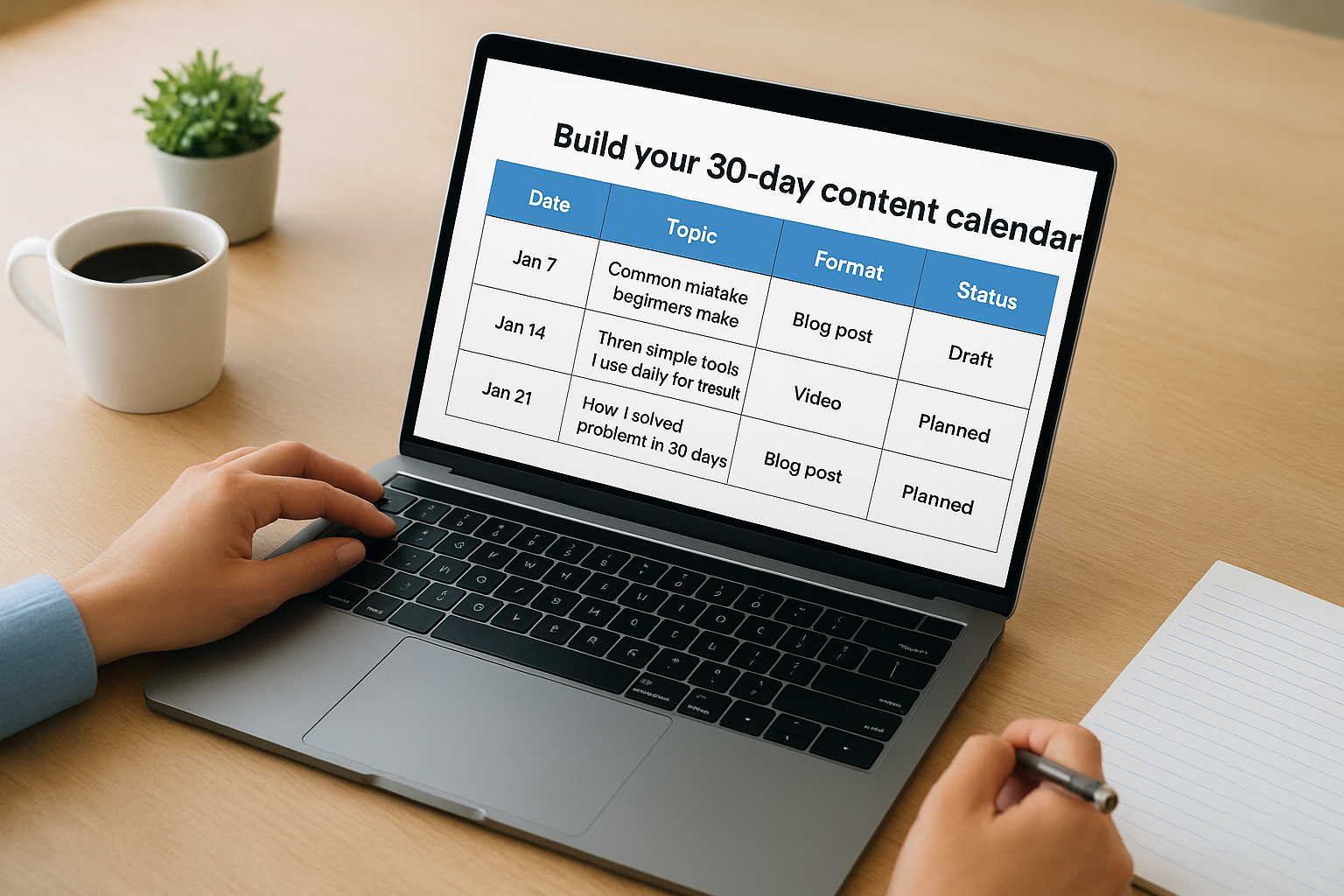
Here’s your starter calendar template:
| Date | Topic | Format | Status |
|---|---|---|---|
| Jan 7 | Common mistake beginners make with [your topic] | Blog post | Draft |
| Jan 14 | Three simple tools I use daily for [result] | Video | Planned |
| Jan 21 | How I solved [specific problem] in 30 days | Blog post | Planned |
| Jan 28 | Why [common advice] doesn’t work for beginners | Video | Planned |
Assign specific topics to specific dates now. This removes decision fatigue and keeps you accountable. You know exactly what you need to create each week before the month begins.
A simple plan you follow beats a perfect plan you abandon.
Schedule two hours every Sunday to review what published, plan next month’s topics, and prepare your next piece of content.
Step 4. Create, publish, and track your content
This step transforms your planning into actual content that attracts customers. You sit down, create your first piece, publish it on your chosen platform, and measure what happens. Content marketing for beginners often fails here because people overthink the creation process or publish without tracking results. The solution combines focused creation sessions with simple measurement that shows you what works.
Create your first piece without perfectionism
Set a 90-minute timer and write, record, or film your content from start to finish. Focus on delivering one clear idea that solves one specific problem from your topic list. Talk directly to your target audience as if explaining the concept to a friend who needs help right now.

Your first draft never needs to be perfect. Get your ideas out completely before you edit anything. If you’re writing, use simple sentences and short paragraphs. People scan content online instead of reading every word, so make your points easy to find and understand.
Follow this creation template for any content type:
- Start with the exact problem your audience faces
- Share one personal story or example that illustrates the problem
- Explain your solution in 3-5 clear steps
- End with one specific action the reader should take next
Edit your draft once to fix obvious errors and improve clarity. Then stop editing and move to publishing.
Done and published beats perfect and invisible every single time.
Publish on your scheduled day
Hit publish on the exact day you planned in your calendar, even if the content feels imperfect. Consistency builds trust faster than quality when you’re starting out. Your audience needs to know you show up reliably before they invest time following you.
Complete these actions immediately after publishing:
- Share the content in one relevant online group or community where your audience gathers
- Send it to your email list if you have one
- Post about it once on your secondary social channel (if you use one)
Spend 15 minutes maximum on promotion per piece. New content creators waste hours promoting one post instead of creating the next piece. Your content library grows faster when you focus on consistent creation over promotional tactics.
Track three simple metrics
Measure only three numbers that tell you if your content works: total views or visitors, engagement actions (comments, shares, likes), and conversions toward your goal (email signups, inquiries, sales). Check these numbers seven days after publishing each piece.
Record your results in this tracking spreadsheet:
| Content Title | Publish Date | Views | Engagement | Conversions | Notes |
|---|---|---|---|---|---|
| [Topic 1] | Jan 7 | 47 | 3 comments | 2 signups | Posted in Facebook group |
| [Topic 2] | Jan 14 | 82 | 8 likes | 1 signup | Video format performed better |
Review your tracking sheet monthly to identify patterns in what performs best. Double down on topics, formats, and promotion methods that generate the most engagement and conversions. Stop creating content types that consistently underperform after testing them three times.
Next steps
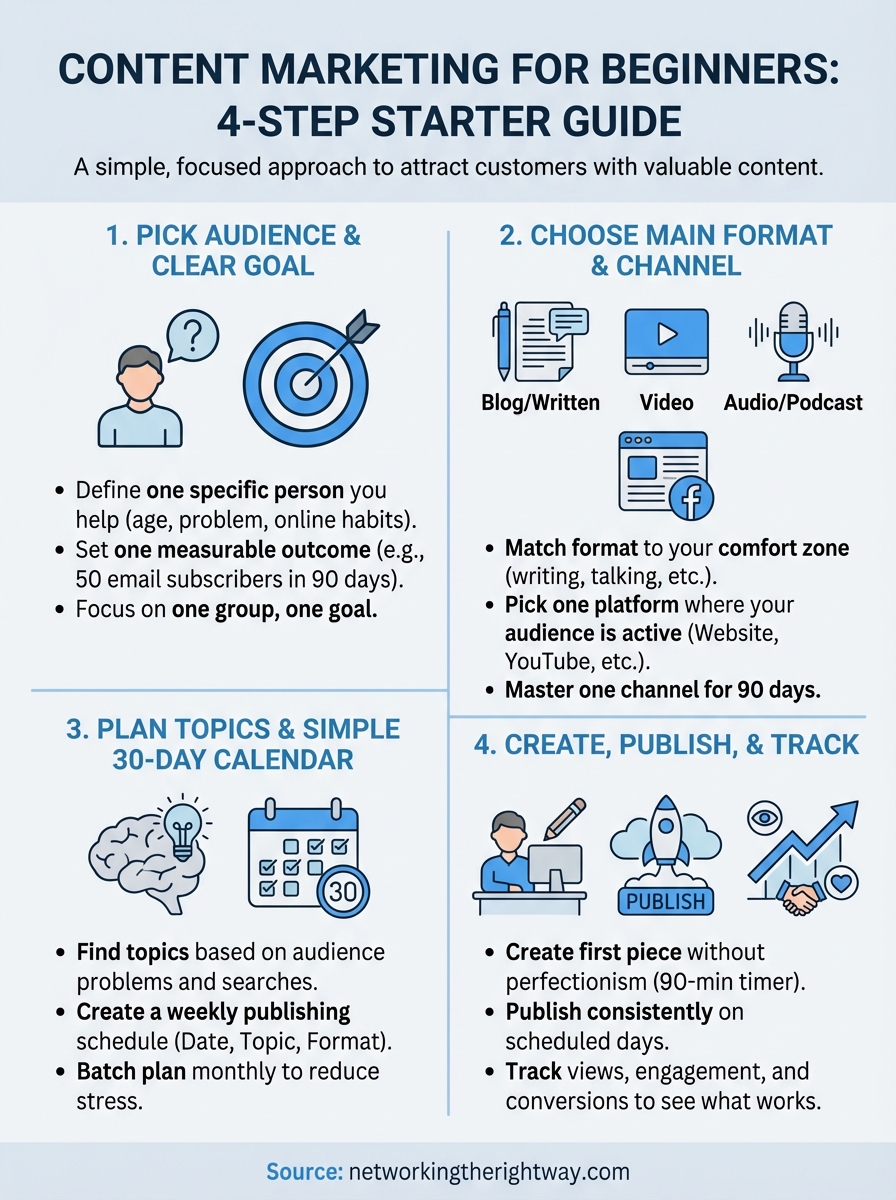
You now have everything you need to start content marketing for beginners today. Pick your one audience and goal from Step 1. Choose your format and platform from Step 2. Plan your first 30 days using Step 3. Then create and publish your first piece following Step 4. The hardest part is always starting, but you’ve eliminated that barrier with this guide.
Set aside time this week to complete your planning. Mark your first publish date on your calendar right now. If you want a proven system that simplifies the entire process, check out this simple way to build a business online. Start creating content that attracts customers instead of waiting for perfect conditions that never arrive.