
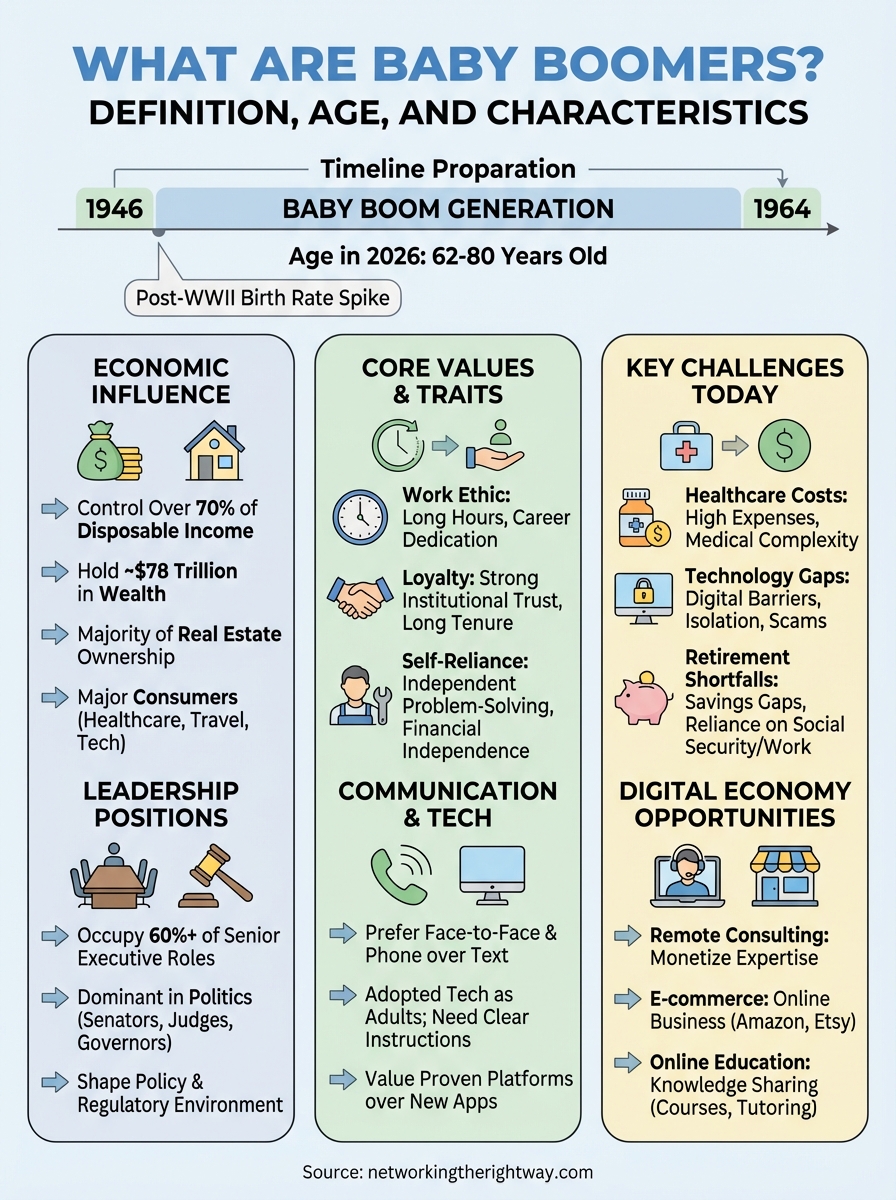
Baby boomers are people born between 1946 and 1964, right after World War II ended. The name comes from the massive spike in birth rates during those years. Today, this generation includes anyone from 62 to 80 years old in 2026. They grew up during a time of economic growth, witnessed major cultural shifts, and now make up one of the largest demographic groups in America. If you were born during this period, you’re part of a generation that shaped modern society in countless ways.
This article breaks down everything you need to know about the baby boomer generation. You’ll discover why understanding this demographic matters, how to identify who belongs to this group, and what core values define them. We’ll explore how boomers differ from younger generations, share current statistics about this age group, and discuss the unique challenges they face today. You’ll also learn about opportunities available in the digital economy and see examples of notable boomers who changed the world. Whether you’re a boomer yourself or simply want to understand this influential generation better, this guide gives you the complete picture.
Why understanding the Baby Boomer generation matters
You can’t navigate today’s economy, workplace, or even your own family dynamics without understanding baby boomers. This generation controls over 70% of disposable income in America and holds more wealth than any other age group. They’re your potential customers, your bosses, your parents, or your clients. Learning what drives them gives you a competitive advantage whether you’re selling products, building relationships, or simply trying to understand the world around you. Their decisions influence everything from housing markets to healthcare policy, and ignoring their impact means missing critical opportunities.
Their economic influence shapes markets today
Baby boomers hold approximately $78 trillion in wealth across the United States as of 2026. This generation owns the majority of real estate, controls significant investment portfolios, and continues to make major purchasing decisions. When you create a product, service, or business strategy, you’re often targeting this demographic whether you realize it or not. They’re spending on healthcare, travel, home improvements, and increasingly on technology and online services. Understanding their preferences means you can position your offerings to capture this massive market share. The spending habits of boomers drive entire industries, from pharmaceuticals to recreational vehicles.
Financial institutions design retirement products specifically for this group. Retailers adjust their marketing strategies based on boomer behavior. Even tech companies have shifted their approach as boomers become more digitally connected. Your understanding of this generation’s economic power helps you make smarter business decisions and identify opportunities others might overlook.
They control most leadership positions
Walk into any boardroom, courtroom, or congressional session, and you’ll find baby boomers holding the majority of decision-making positions. This generation occupies over 60% of senior executive roles in major corporations across America. They set company policies, determine industry standards, and shape the regulatory environment you operate within. Your career advancement often depends on understanding how these leaders think, what they value, and how they make decisions. Their leadership style differs significantly from younger generations, emphasizing hierarchy, experience, and proven track records.
Understanding the values and communication preferences of boomer leaders can accelerate your professional growth and help you navigate workplace dynamics more effectively.
Political power remains concentrated in this age group as well. Most senators, governors, and federal judges are boomers who create the laws and regulations affecting your daily life. Their legislative priorities reflect generational concerns, from Social Security reform to healthcare access. Recognizing these priorities helps you anticipate policy changes and adapt accordingly.
Understanding them helps you connect across generations
Your parents, grandparents, or older colleagues likely belong to this generation. Building strong relationships with boomers requires understanding their unique perspectives shaped by historical events like the Vietnam War, the civil rights movement, and the moon landing. They approach communication differently than younger people, often preferring phone calls over text messages and valuing face-to-face interactions. When you grasp these preferences, you create deeper connections both personally and professionally.
Boomers bring institutional knowledge and experience that younger generations lack. They’ve weathered multiple economic recessions, adapted to technological revolutions, and built successful careers through different market conditions. Learning from their experiences saves you from repeating costly mistakes. They also represent your future customers as you age into entrepreneurship or business ownership. The digital skills gap many boomers face creates opportunities for those who can bridge that divide with patience and clear instruction.
Families span multiple generations, and understanding boomers helps you maintain harmony during holidays, navigate inheritance discussions, and provide appropriate care as they age. Professional relationships benefit too when you can communicate effectively with older clients, mentors, or business partners who see the world through this generational lens.
How to identify a Baby Boomer
You can spot a baby boomer by looking at their birth year and age, but the generation reveals itself through more than just numbers. Someone born between 1946 and 1964 falls into this category, making them 62 to 80 years old in 2026. Beyond these dates, you’ll recognize boomers through their shared cultural experiences, communication styles, and approach to technology. They reference historical events that shaped their worldview and often display work habits formed during different economic times. Understanding these markers helps you identify who belongs to this generation and anticipate how they’ll respond in various situations.
By birth year and age range
The clearest identifier is the 1946 to 1964 birth window, a precise 18-year span following World War II. You can calculate someone’s birth year by subtracting their age from 2026. Anyone currently 62 years old was born in 1964, while those who are 80 turned that age with a 1946 birth year. This generation splits into two distinct groups: older boomers born from 1946 to 1955, and younger boomers born from 1956 to 1964. The older group experienced the 1960s counterculture as teenagers and young adults, while younger boomers came of age during the economic turbulence of the 1970s and early 1980s.
Government agencies, marketing firms, and researchers use these birth years to segment data and create targeted strategies. When you see demographic reports about retirement trends, healthcare utilization, or consumer spending by age group, they’re often tracking this generation using these exact dates. Your own family tree provides another identification method. If your parents or grandparents remember where they were during the Kennedy assassination, watched the moon landing live, or participated in Woodstock-era cultural movements, they likely belong to this generation.
By generational experiences and references
Baby boomers share cultural touchstones that younger people only know from history books. They remember rotary phones, black-and-white television broadcasts becoming color, and a time before personal computers existed in homes. Their musical references include The Beatles, Elvis Presley, and Motown, artists they experienced during their original popularity rather than through revivals. You’ll hear them mention Vietnam War protests, the civil rights movement, or Watergate as events they witnessed firsthand. These shared memories create an immediate connection between boomers when they meet.
When boomers reference historical events, they’re not showing off knowledge but sharing experiences that genuinely shaped their formative years and core beliefs.
Their relationship with technology reveals generational patterns too. Boomers adapted to digital tools during their adult years rather than growing up with them. They learned email in their 30s or 40s, adopted smartphones later than younger generations, and often ask for help with new apps or platforms. You’ll notice they prefer phone calls over texting and value in-person meetings more than video conferences. This doesn’t mean they reject technology, but rather that they approach it as something to master through practice rather than intuition. Their LinkedIn profiles might be less polished than younger professionals, and they often maintain Facebook accounts as their primary social media platform.
Core values and characteristics of the generation
Baby boomers developed distinct values shaped by their upbringing during post-war prosperity and social upheaval. You’ll find that this generation prioritizes work ethic, values face-to-face relationships, and believes in earning success through dedication and persistence. They grew up in an era when jobs offered lifetime employment, pensions were standard, and a college degree guaranteed career advancement. These conditions forged a mindset focused on loyalty, stability, and traditional achievement markers like homeownership and climbing corporate ladders. Understanding these core characteristics helps you predict their behavior in business dealings, family matters, and social interactions.
Work ethic and career dedication
You’ll notice boomers approach work with intense commitment and long hours. This generation invented the 60-hour workweek and made "workaholic" a common term. They measure success through job titles, salary increases, and years of service at companies. When you work alongside boomers, expect them to arrive early, stay late, and view paid time off as something to earn rather than freely use. Their identity often connects directly to their careers, answering "What do you do?" with their job title before anything else.
Boomers typically view work as the primary path to fulfillment and respect, prioritizing career advancement over work-life balance in ways that younger generations find outdated.
This dedication stems from watching their parents sacrifice during World War II and experiencing an economy where hard work consistently led to promotions and financial security. They believe effort directly correlates with rewards, a perspective that can clash with younger workers who prioritize flexibility and purpose over tenure.
Loyalty and institutional trust
Boomers demonstrate strong loyalty to institutions they believe in, from employers to political parties to religious organizations. You’ll find they stay with one company for decades, expecting that loyalty to be reciprocated through job security and pensions. They trust established systems more than younger generations, respecting government agencies, large corporations, and traditional media outlets. Banking with the same institution for 40 years seems normal to them, as does maintaining decades-long relationships with doctors, lawyers, and other professionals.
Their loyalty extends to brands and products too. Once they find something that works, they stick with it rather than constantly seeking new options. This characteristic makes them valuable long-term customers but harder to convert from competitor offerings.
Self-reliance and independence
Self-sufficiency defines much of the boomer mindset. They value solving problems independently and often resist asking for help until absolutely necessary. You’ll see this generation attempt home repairs, manage their own investments, and tackle challenges without immediately seeking expert assistance. This independence grew from childhood experiences with minimal parental supervision compared to later generations. They played outside unsupervised, solved their own disputes, and learned through trial and error.
Financial independence ranks as a primary goal too. Boomers prioritize owning homes outright, maintaining emergency savings, and avoiding debt whenever possible. They view relying on others, including adult children, as failure rather than normal family support.
How Baby Boomers differ from other generations
Baby boomers stand apart from Generation X, Millennials, and Gen Z through fundamental differences in values, work habits, and worldview. You’ll notice these distinctions most clearly when comparing communication styles, technology adoption, and career expectations across age groups. While younger generations grew up with instant digital connectivity and frequent career changes, boomers experienced a slower-paced world built on face-to-face relationships and long-term stability. These contrasts create both friction and opportunity in workplaces, families, and consumer markets. Understanding exactly how boomers diverge from other generations helps you navigate intergenerational dynamics more effectively.
Technology adoption and digital comfort
Boomers learned technology as adults adapting to change rather than digital natives who grew up with smartphones and social media. You’ll find they prefer traditional methods of communication like phone calls and email over text messaging and instant messaging platforms. Their social media use centers primarily on Facebook for staying connected with family, while younger generations spread across multiple platforms like Instagram, TikTok, and Snapchat. When learning new software or apps, boomers typically need step-by-step instructions and written guides rather than figuring things out through experimentation.

Boomers view technology as a tool to accomplish tasks rather than an integrated part of daily life, which explains their selective adoption and preference for proven platforms over trendy new apps.
Banking habits reveal this divide too. Boomers still visit physical bank branches and write checks, while Millennials and Gen Z conduct most financial transactions through mobile apps. This doesn’t mean boomers reject digital tools entirely. They’ve embraced online shopping, video calling with grandchildren, and streaming entertainment services. Their adoption just happens more deliberately and selectively than younger groups.
Career expectations and job stability
You’ll notice boomers expect linear career progression within single companies, contrasting sharply with younger workers who change jobs every few years. This generation views company loyalty as a two-way street, expecting employers to reward tenure with promotions, raises, and job security. Generation X, Millennials, and Gen Z prioritize career flexibility, remote work options, and purpose-driven employment over staying put. Boomers measure success through titles and salary, while younger generations value work-life balance and personal fulfillment equally or more.
Retirement planning differs dramatically across generations too. Boomers relied on employer pensions and Social Security as their primary retirement funding sources. Younger workers shoulder complete responsibility for retirement savings through 401(k) plans and individual investment accounts, creating different financial stress points and planning strategies. Job security meant everything to boomers, while younger generations accept frequent career pivots as normal and even beneficial for growth.
Communication preferences and social interaction
Face-to-face meetings remain the gold standard for boomers conducting business or maintaining relationships. You’ll see them schedule in-person lunches, office meetings, and social gatherings rather than defaulting to video calls or messaging. Their professional correspondence tends toward formal language and complete sentences, while younger generations embrace brevity, emojis, and casual tone even in work contexts. Boomers answer phone calls immediately and expect the same responsiveness, whereas Millennials and Gen Z often let calls go to voicemail and respond via text later.
Key statistics regarding Baby Boomers in 2026
Numbers tell the story of baby boomers’ massive influence on American society. You’re looking at a generation that comprises approximately 69 million people in the United States as of 2026, representing about 21% of the total population. This demographic segment continues shrinking annually due to natural mortality rates, but their economic and social impact remains enormous. Understanding these statistics helps you make informed decisions whether you’re marketing products, planning services, or simply grasping how this generation shapes modern America. The data reveals patterns in spending, retirement, health, and digital engagement that affect everything from housing markets to healthcare demand.
Population and demographic numbers
The boomer population decreased from its peak of 78 million in 1999 to the current 69 million as members of this generation reach their senior years. You’ll find that approximately 10,000 boomers turn 65 every single day in 2026, a trend that continues until the youngest members hit this traditional retirement age in 2029. Gender distribution shows slightly more women than men in this age group, with women comprising about 52% of the boomer population due to longer average lifespans. Geographic concentration reveals that California, Texas, and Florida hold the largest boomer populations, with these three states accounting for nearly 30% of all boomers nationwide.
The daily retirement rate of 10,000 boomers creates unprecedented strain on Social Security, Medicare, and healthcare systems while simultaneously opening job opportunities for younger workers.
Economic impact and wealth distribution
Baby boomers control $78.6 trillion in total wealth, representing more than half of all wealth in the United States. Their median household income sits at $74,900 annually, higher than any other generational cohort. Homeownership rates among boomers reach 78.8%, and they own properties valued at an average of $385,000. You’ll discover that boomers hold approximately $13.5 trillion in retirement accounts, though distribution varies widely with the top 10% controlling the majority of these assets. Consumer spending by this generation totals $548 billion annually on discretionary purchases alone, excluding essentials like housing and healthcare.

Workforce and retirement trends
The workforce still includes 29 million baby boomers who remain employed either full-time or part-time in 2026. This represents 42% of the total boomer population continuing to work past traditional retirement age, with many citing financial necessity or personal fulfillment as primary reasons. Labor force participation drops sharply after age 70, but 16% of boomers over 70 still maintain some form of employment. Retirement savings show concerning gaps, with 45% of boomers reporting less than $250,000 in total retirement funds and 28% having no retirement savings whatsoever. Healthcare costs consume approximately 15% of annual income for retired boomers, a percentage that increases significantly for those over 75 years old.
Common challenges facing Boomers today
Baby boomers face a unique set of obstacles that didn’t exist for previous generations at this stage of life. You’re watching this demographic navigate rising healthcare costs, rapid technological changes, and uncertain financial futures simultaneously. These challenges affect every aspect of their daily lives, from managing chronic health conditions to staying connected with family members. Understanding what boomers struggle with helps you recognize opportunities to provide solutions, offer support, or simply appreciate the complexity of aging in modern America. The problems they encounter reflect broader societal shifts in healthcare delivery, workplace expectations, and economic structures that impact everyone eventually.
Healthcare costs and medical complexity
Medical expenses consume an average of $7,000 annually for each boomer, even with Medicare coverage. You’ll find that prescription drug costs alone drain retirement savings faster than anticipated, with many boomers taking four or more medications daily to manage chronic conditions. Medicare doesn’t cover dental, vision, or hearing care, forcing boomers to choose between necessary treatments and other expenses. Navigating insurance options creates confusion and stress, particularly during annual enrollment periods when decisions about supplemental coverage determine out-of-pocket costs for the entire year.
Healthcare expenses represent the single largest variable cost in retirement planning, often exceeding housing costs for boomers with chronic health conditions or limited supplemental insurance.
Coordinating care among multiple specialists adds another layer of difficulty. Boomers manage appointments, test results, and treatment plans across different medical systems that rarely communicate effectively with each other. This fragmentation leads to medication conflicts, duplicate testing, and gaps in care that compromise health outcomes.
Technology gaps creating isolation
Digital tools that younger generations use effortlessly present significant barriers for many boomers. Online banking, telehealth appointments, and digital communication with grandchildren all require comfort levels with technology that some members of this generation never developed. You’ll see them struggling with smartphone features, video conferencing software, and two-factor authentication systems designed without their needs in mind. This technological divide creates real isolation as more social interaction, healthcare access, and essential services move exclusively online.
Scams targeting older adults exploit these knowledge gaps ruthlessly. Boomers lose billions of dollars annually to phishing emails, fake tech support calls, and romance scams because they lack the digital literacy to recognize sophisticated fraud attempts.
Retirement savings shortfalls
Financial reality falls short of expectations for millions of boomers who discover their retirement savings won’t support their lifestyle or even cover basic needs. Social Security replaces only 40% of pre-retirement income on average, forcing many to continue working out of necessity rather than choice. Market volatility during the 2008 financial crisis decimated retirement accounts for boomers in their prime earning years, leaving insufficient time to recover losses before retirement age arrived.
Housing wealth creates additional stress as boomers face decisions about downsizing, reverse mortgages, or aging in place with increasing maintenance costs and property taxes on fixed incomes.
Opportunities for Boomers in the digital economy
The digital economy opens doors that didn’t exist during most of baby boomers’ careers. You can leverage decades of professional experience and turn knowledge into income through online platforms that require minimal startup costs. Technology creates opportunities for flexible work arrangements, location independence, and new revenue streams that align perfectly with retirement goals or the need to supplement fixed incomes. Your expertise holds tremendous value in digital marketplaces where clients actively seek seasoned professionals who understand business fundamentals and can deliver results. The shift to remote work, online education, and digital services means you don’t need to master complex technology to participate, just enough digital literacy to access platforms designed for ease of use.
Remote consulting and expertise monetization
Your career experience translates directly into consulting opportunities that clients will pay premium rates to access. Platforms like LinkedIn connect you with businesses seeking strategic advice, project management, or industry-specific knowledge that only comes from years in the field. You set your own hourly rates, choose your clients, and work from home without commuting or maintaining expensive office space. Companies increasingly hire fractional executives and consultants instead of full-time employees, creating steady demand for experienced professionals who can solve problems quickly.

Consulting allows you to monetize specific expertise while maintaining complete control over your schedule and workload, making it ideal for boomers seeking income without full-time commitment.
Retainer agreements provide predictable monthly income while you help businesses navigate challenges you’ve already solved in your own career. Virtual meetings replace travel, saving time and energy while expanding your potential client base beyond your local area.
E-commerce and online businesses
Selling products through Amazon, eBay, or Etsy requires no physical storefront and minimal technical skills. You can start with items you already own, test market demand, and scale based on results without risking significant capital. Dropshipping models eliminate inventory management entirely, letting you run a retail business from your laptop while suppliers handle storage and shipping. Digital products like templates, guides, or printables generate passive income once created, selling repeatedly without additional work or inventory costs.
Service-based businesses thrive online too. Virtual assistants, bookkeepers, and customer service representatives all work remotely for companies seeking reliable, professional support. Your communication skills and work ethic make you more attractive than younger candidates for roles requiring attention to detail and accountability.
Online education and knowledge sharing
Teaching what you know creates multiple income streams through platforms like Udemy, Skillshare, or private course websites. You record lessons once and earn royalties each time someone enrolls, building passive income that continues indefinitely. Tutoring services connect you with students globally who need help with subjects you mastered during your education or career. Writing ebooks or creating instructional content positions you as an authority in your field while generating sales that require no ongoing effort after publication.
Notable Baby Boomers who shaped the world
Baby boomers built the modern world you live in today. You encounter their innovations, products, and ideas every single day without realizing this generation created them. From the technology you use to the entertainment you consume, boomers transformed every industry they entered. Their achievements prove that this generation didn’t just witness change but actively drove it forward. Looking at specific examples shows you the massive influence individual boomers wielded across business, culture, politics, and technology. These success stories also demonstrate that age never limited their ability to adapt, innovate, and create lasting impact.
Technology and business innovators
Bill Gates (born 1955) co-founded Microsoft and built the personal computer revolution that changed how you work, communicate, and access information. His software powered the digital transformation of business and home computing worldwide. Steve Jobs (1955-2011) created Apple and gave you the iPhone, iPad, and MacBook that define modern mobile computing. Jeff Bezos, born in 1964, started Amazon as an online bookstore and transformed it into the e-commerce giant that delivers products to your door within days. These business leaders didn’t inherit their success but built companies from scratch during their working years, proving entrepreneurship has no age limit.
The technology platforms baby boomers created now offer the same generation opportunities to build online businesses and earn digital income, bringing their entrepreneurial journey full circle.
Oprah Winfrey (born 1954) built a media empire from a local talk show, becoming one of the wealthiest self-made women in America. Her influence extends beyond entertainment into publishing, film production, and digital media platforms.
Cultural and entertainment icons
Music changed forever through boomer artists who created genres and sounds that still dominate charts today. Madonna (born 1958) revolutionized pop music and female performance, while Bruce Springsteen (born 1949) gave voice to working-class America through rock anthems. Film directors like Steven Spielberg (born 1946) and George Lucas (born 1944) created the blockbuster movie industry with franchises like Star Wars and Indiana Jones that continue generating billions in revenue. These cultural figures adapted repeatedly to changing media landscapes, staying relevant across decades.
Political and social leaders
Political power remains concentrated among baby boomers who shaped both conservative and progressive movements. Bill Clinton (born 1946) and George W. Bush (born 1946) served as presidents during pivotal economic periods, while Barack Obama, though often grouped younger, was born in 1961 and technically qualifies as a late boomer. Their policies affected retirement systems, healthcare access, and economic regulations that impact your daily life today.
Wrapping up the Baby Boomer definition
Baby boomers are the 76 million Americans born between 1946 and 1964 who shaped modern society through their values, spending power, and cultural influence. You now understand that this generation values hard work, loyalty, and independence while controlling the majority of wealth in America. Their unique characteristics stem from growing up during post-war prosperity and witnessing massive social changes. Whether you’re a boomer yourself or work with this demographic, recognizing their preferences and challenges helps you navigate business, family, and social situations more effectively.
The digital economy presents real opportunities for baby boomers seeking supplemental income or new careers. Your decades of experience hold tremendous value in online marketplaces where clients pay premium rates for proven expertise. Building an online business doesn’t require advanced technical skills anymore. If you’re ready to transform your knowledge into income, check out this simple way to build a business online designed specifically for your generation’s needs and strengths.